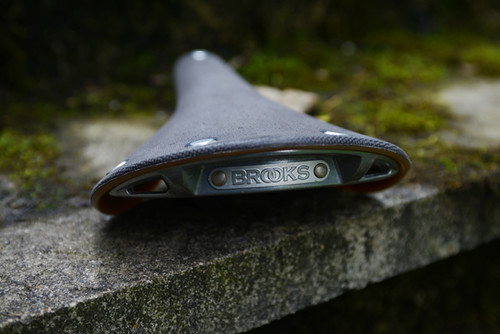
Earlier this year Brooks surprised their fans by announcing the release of a non-leather saddle: theCambium C-17. Selected to be one of the beta-testers, I must have been in the very last wave of recipients, because the saddles have been out for months now and mine arrived only last week. About to head back to Ireland, I threw it in a suitcase and, after several days of jetlag, have now finally managed to get a good look. I have not tried the Cambium on a bike yet, but wanted to post some shots and first impressions, figuring many of you are as curious as I was. And there is good reason to be curious: The Cambium is quite a departure for Brooks of England - a storied manufacturer whose very claim to fame is its leather saddles.
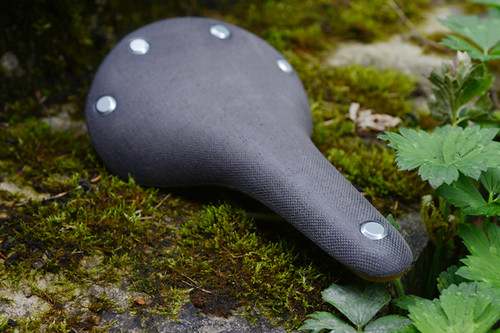
As Brook describes it, the Cambium C-17 is made "from vulcanized natural rubber and organic cotton enhanced by a thin layer of structural textile for added resilience." Considering this is a bike saddle, I'd assumed the fabric would be treated with something to make the surface smooth. But the surface has a distinct texture to it similar to that of artist's canvas or some types of denim. While it's been treated for stiffness and waterproofing, there remains a bit of tooth to it. For that reason I have to admit, I am reluctant to try this saddle with lycra cycling shorts - which can be delicate and abrasion-prone in the seat area. But I'll do it, and will let you know how it goes.
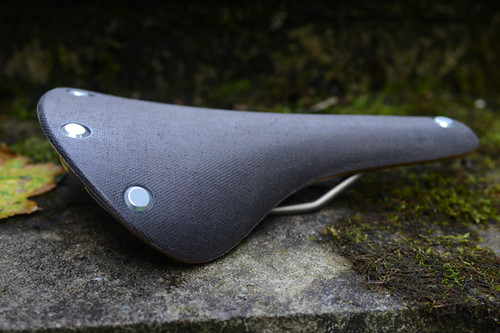
As far as looks, the one word that comes to mind in describing the Cambium is "subtle." This is a minimalist, low key saddle, not an ostentatious one. The colour of the cloth is half way between gray and taupe. In person, it can look either charcoal gray, ashy brown or even mauve, depending on what it's placed next to. This is rather nice, in the sense that it will match pretty much any bike. The brooks logo is stamped tone on tone into the rear of the undercarriage and is only noticeable close-up. The metal bits are matte, almost dull. The overall shape is somewhere between a Brooks B-17 and an '80s style vinyl racing saddle.
While the Cambium's "C-17" label suggests it has the same dimensions as the B-17 touring saddle, this is not the case: The C-17 is narrower (162mm across, compared to the B-17's 175mm), longer (283mm, compared to the B-17's 275mm), and has less height to it (52mm, compared to the B-17's 65mm). The Cambium should be suitable for a more aggressive bike position than the B-17. The weight of the Cambium is 415g (compared to 520g of the standard B-17). The ladies' version - the C-17S - is the same as the C17 in every way, except 18mm shorter and 10g lighter.

I did not receive any special insight into the Cambium's construction from Brooks, so I am just describing what I see. It looks like the undercarriage is modular, similar to Berthoud, with (rivet-shaped) screws instead of rivets.
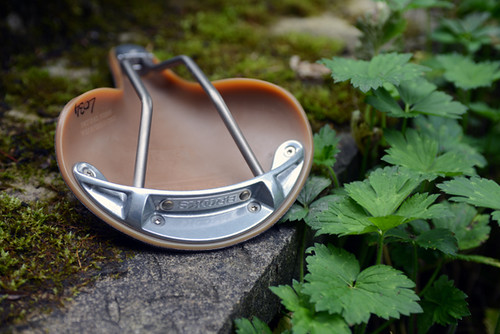
The matte metal resembles titanium, but it is not labeled or described as such, so I assume it is cro-moly.
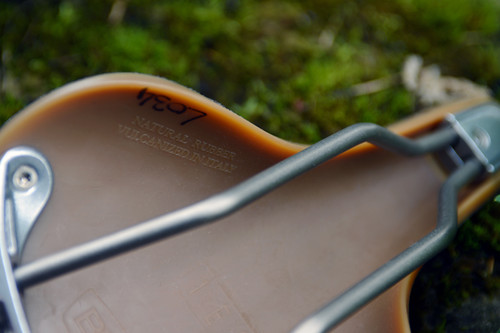
Stamped "natural rubber vulcanized in Italy," the saddle is extremely flexible - I can easily bend and twist it with my hands. I imagine Brooks was trying to replicate the hammocking/ suspension qualities inherent to their leather saddles, and this was the solution they came up with. I am eager to experience the feel of this on a bike - especially on bumpy roads, chipseal and gravel.
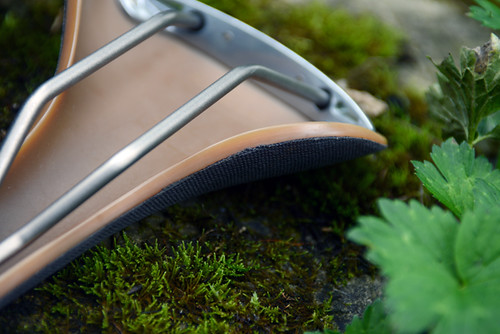
The surface layer of cotton fabric is cut to form and glued onto the rubber. While the construction looks to be top notch, one potential problem I can see, is that over time the edges might begin to lift. Only long term use can determine whether this proves to be the case.
As I see it, the potential appeal of this saddle is two-fold: Those who do not use leather for ethical reasons will welcome a non-leather option from Brooks. And those who dislike how much Brooks leather saddles change shape over time might prefer the stability of the Cambium's construction.It is also interesting how Brooks went with natural, rather than synthetic materials in constructing this saddle, in keeping with its usual aesthetics. The C-17 will look good on a wide range of bikes, classic and modern.
Well, that is all for now. I am going to try this saddle on a semi-upright pathrace-style bike, then on my roadbike, and report back in a couple of weeks. If you have any questions in the meantime about the construction, shape or aesthetics, feel free to ask. In fairness to Brooks, I would like to note that I was not asked to write about the saddle on this blog or to publicise it in any way; my role as a beta-tester involves only private feedback. I believe the Cambium C-17 and C-17S will be available for sale in September, as a limited edition release. You can see its full specs, as well as read feedback from those who were in the earlier waves of testers, here.


 Matt had a good time seconding the climb and getting back onto ice after so manyyears. We left it rigged on the shuts and walked down. We took turns climbing thequickly deteriorating ice. We finished up a little before 3 o'clock. Whilepacking up our gear Dr. Bob and Regina camewalking up thetrail to the cliff.We briefly chattedthen let themget to climbing as the routedidn't appear that it would be climbablemuch longer.Surprisingly the hike outfelt a little better than the hike in.At one point Laura hopped on thesledwith all the gear to take the easy way out. She was grinning ear to ear duringher 1/2 mile of sleighing through the woods.She was surprised I could manage the load and her. It was the least I could do since I didn't get hera valentines present this year.At the car we snapped a photo and made our way to dinner atTall Cedars in Donegal. We all agreed that the day was a lot offun. The weather was warm and it was great to getMatt on the elusive route. Remember Matt, the cliff is always 10min. away!
 Laura climbing Flying Dutchman. Photo TA


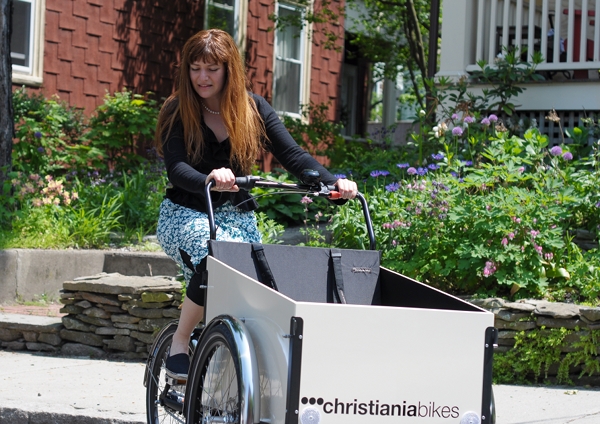 If you've been hoping for a change of pace from the recurring roadcycling theme, your wish is granted. Yesterday I had a visit from Will of BoxCycles - an importer of European utility bicycles whose warehouse is not far from Boston. The purpose of the visit was to drop off one of these - but more on that later! In the meantime, he was also delivering thisChristiania cargo trike to someone local, and I had the opportunity to try it.
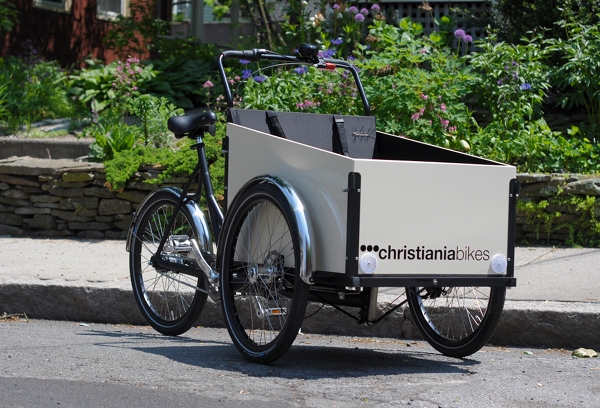 Christiania Bikes have been around since 1976, initially as a small workshop in the Freetown Christianianeighbourhood of Copenhagen, Denmark. If you do not already know the history of this unusual neighbourhood, it's worth looking into - very interesting stuff. In addition to Christiania bikes, the modern incarnation of Pedersen began there as well. Having over time expanded, Christiania now has a factory on Bornholm Island. Their cycles remain manufactured, finished and assembled by hand - the most popular model being the cargo trike shown here.
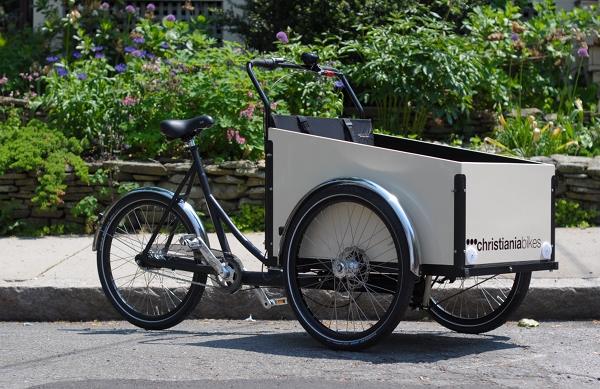 Though I occasionally see cargo trikes both in Europe and in the US, this is the first time I've examined one so closely. The Christianiais aheavy-duty welded aluminum frame with three 24" wheels: two in front and one in rear. The cargo box is positioned between the front wheels and the cyclist steers with it when turning. The box is plywood, and there are several models available in different widths and lengths. This trike is 82" long and 34" wide, weighing 75lb when empty. It accommodates 100kg (220.5lb) of weight can can be used for anything from hauling cargo to transporting children.
 Inside the box is a bench with padded seat cushions and two sets of seatbelts. Given the weight capacity, this trike can easily fit several children, or even an adult or two.
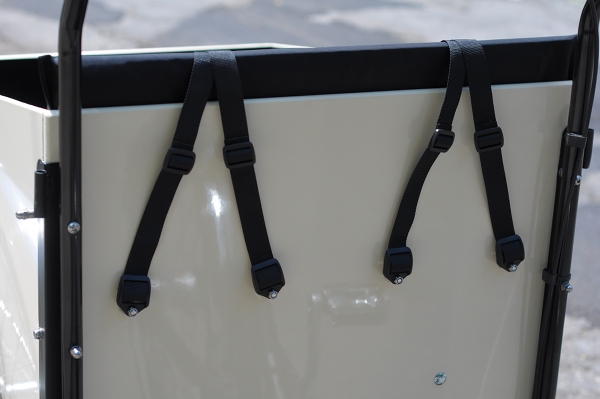 Seatbelt attachment points on the back of the box.
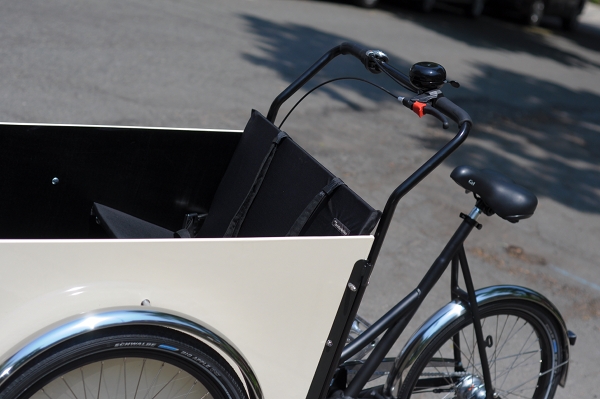 The handlebars are not really handlebars at all, but more like a pram or shopping cart handle.
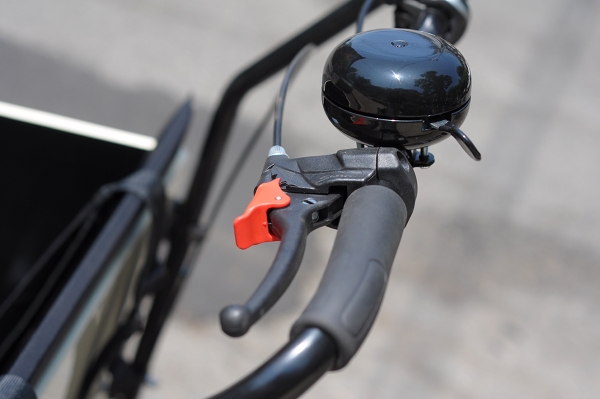 The lefthand side is set up with a front brake lever, parking brake and bell. A parking brake is necessary with a cargo trike; without one it will roll down even the tiniest inclines.
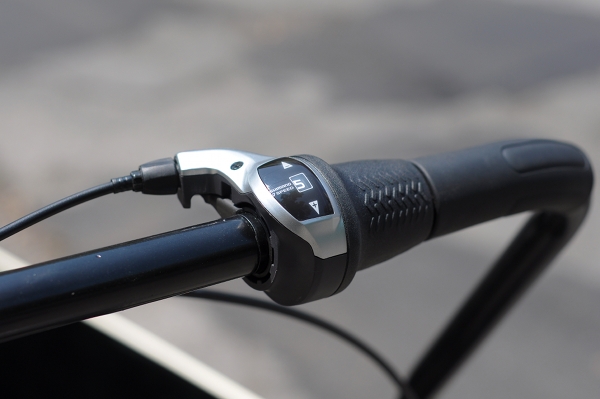 The righthand side is set up with a gear shifter. The trikes are available as either 7 or 8 speeds.
 Shimanocoaster brake hub, clear chainguard, massive cranks and non-slip pedals.
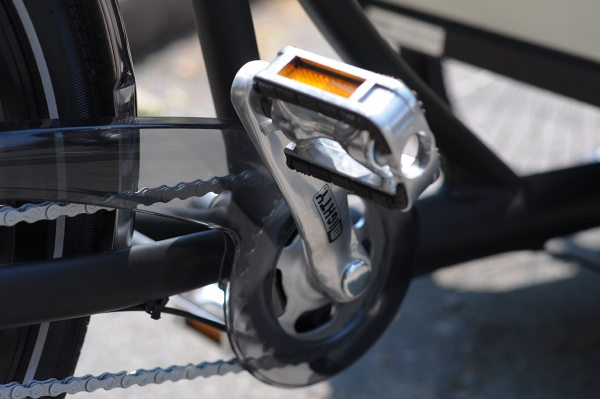 The chainguard provides good coverage, though it is not a full chaincase.
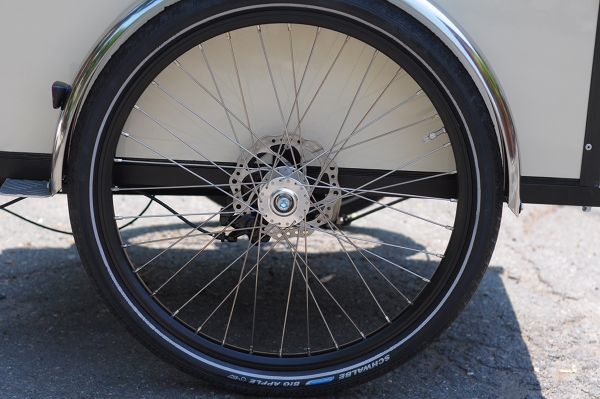 The front wheels are set up with disk brakes, which are activated by the hand lever. Tires areSchwalbeBig Apple.
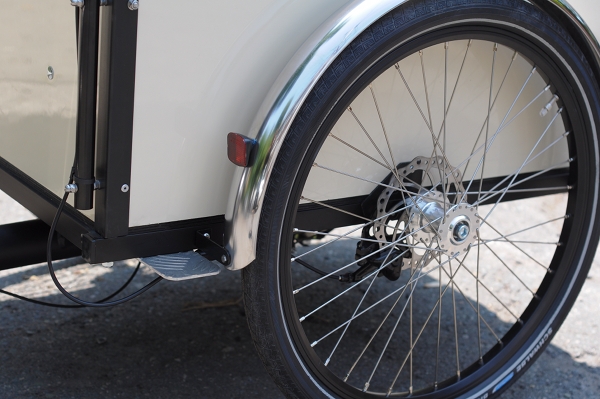 Rear reflectors are affixed to the fenders of each wheel. A dynamo lighting package is available with his model, using a bottle generator on the rear wheel (you can see the attachment arm for it here).
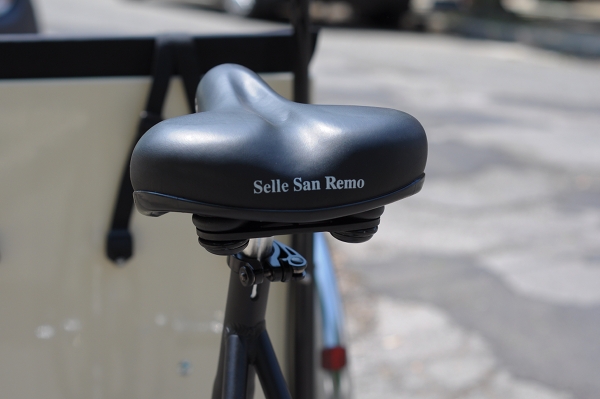 The stock saddle is a plushy vinyl SelleSan Remo.
 I rode the trike briefly and clumsily, so I better use the pictures I took of Will to show you how it works. To operate the trike, you basically need to point the box, using that one long handle, in the direction you need to go. This sounds simple enough, but if you've never ridden this kind of trike before it is completely counter-intuitive. The other thing that takes getting used to is that when turning, the box pivots on its axel and becomes parallel to the cyclist - not unlike a swing bike!
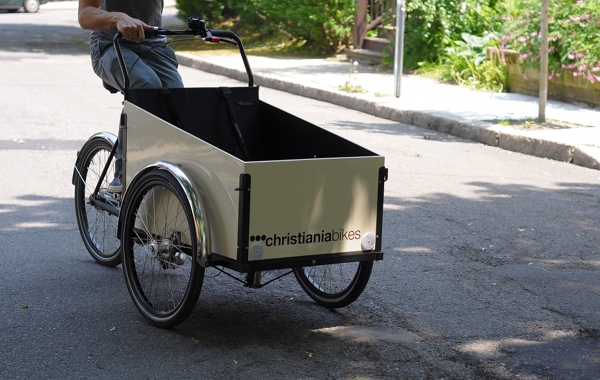 Watch this: Here is the trike going straight.
 And here is what happens when turning. Crazy!
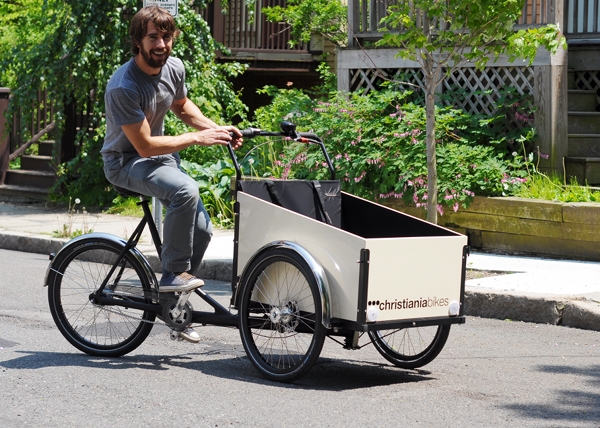 Those who own one of these trikes say it takes about a day to get the hang of the steering, but that once you do it becomes second nature. While I have no experience with other trikes, there is a nice test ride report on Suburban Bike Mama where she compares the Christianiato her own Sorte Jernhest. I've also seen a couple of Christianiasaround Boston at this point, and the owners seem pretty adept at steering.
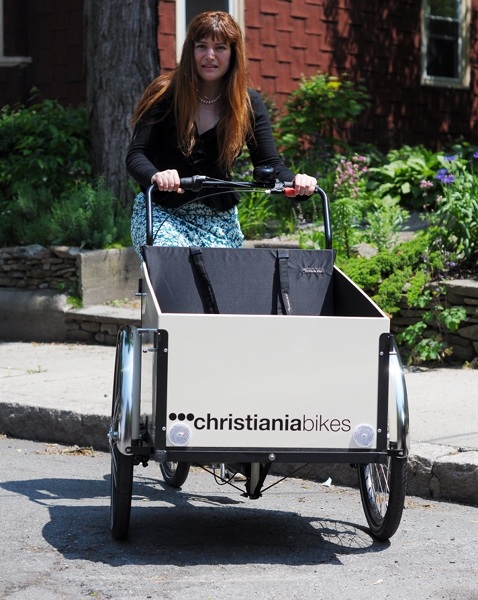 If we continue to live without a car (which at this point seems likely), it is possible that I may want to get some massive cargo hauling contraption in the future, which is why I was curious to test ride one of these. One thing that surprised me about the unloadedChristianiais how light it felt. I expected the trike itself to be heavy and clunky, but it has an almost airy feel to it without cargo. It rolls easily, including up the mild incline of my street. Once it is filled with 100lbs of stuff I am sure the handling will be different, but it is nice to know how the trike behaves on its own as well. Making turns felt wild and tippy, but also a lot of fun. Since others are able to grasp it in a day, I am sure I would as well. My one source of ambivalence toward the Christiania, is that it seems designed specifically to transport children, which is not what I would need a cargo bike for. It's not only the benches (which I am sure are optional), but also that long handle and something about the general look that, to me at least, makes it resemble a giant pram. I can just imagine using this trike to carry equipment and being constantly asked how many kids I have. Having said that, I think that most people considering a cargo trike like this do in fact plan to transport children, which would make what I am describing a good thing. If drivers see you on the road and think "baby carriage!" they will probably be more careful and will give you more room.